
AAQuant
<h2>Building an autonomous research organisation</h2>
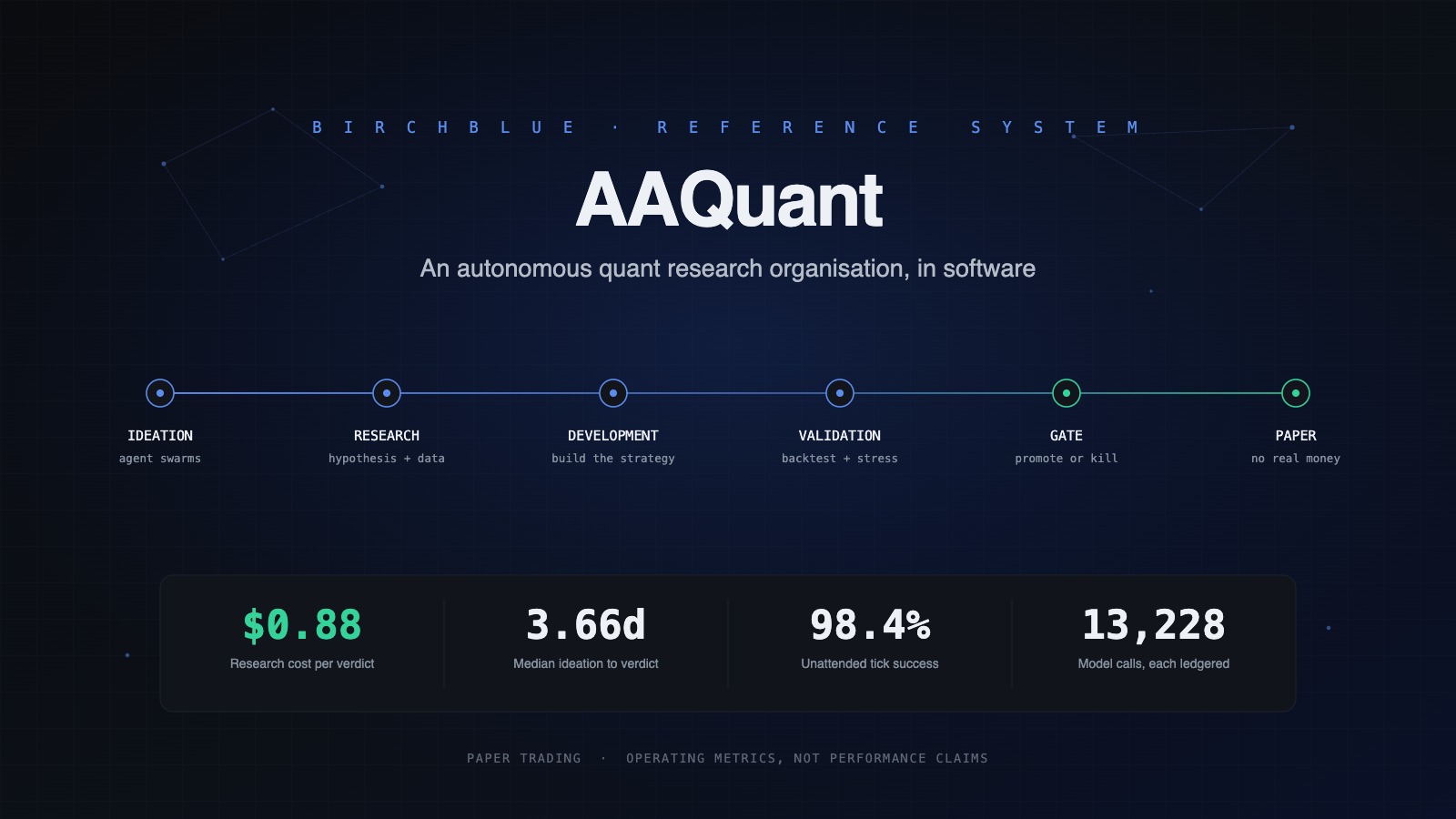
AAQuant is an AI-native quant fund. Birchblue built its operating system: the agent orchestration, the governance layer, the statistical gate stack, and the cost controls that let it run unattended.
This page covers the engineering. For the fund itself — strategy, data moat, and investor information — see <a href="https://aaquant.ai" target="_blank" rel="noopener">aaquant.ai</a>.
<h2>The engineering problem</h2>
Quantitative research is human-serial and therefore expensive. A researcher takes a hypothesis, builds it, backtests it, argues for it, and usually discovers it has no edge — after weeks of work. The question was whether that discovery loop could be delegated to a governed agent workforce without lowering the statistical bar.
<h2>What we built</h2>
<ul>
<li><strong>A six-stage governed state machine</strong> carrying every hypothesis from ideation through research, development, validation, and paper deployment — unattended.</li>
<li><strong>Tiered model routing across five classes.</strong> Every feature declares the model class its work requires and the runtime enforces it. Mismatches between intended and actual model are flagged automatically.</li>
<li><strong>A tamper-evident audit chain.</strong> Every state transition, gate verdict, and model call written to an HMAC-SHA256 chain with model, tokens, cost, and prompt hash.</li>
<li><strong>A statistical gate stack</strong> — deflated-Sharpe critic at 90% confidence, correlation gate, four-layer decay detection with false-kill guards.</li>
<li><strong>Self-healing operations.</strong> Supervisor daemon with per-step retry, dead-letter, and escalation; liveness probes; daily machine-written postmortems.</li>
</ul>
<h2>Operating results</h2>
<table>
<tbody>
<tr>
<td><strong>Research cost per terminal verdict</strong></td>
<td><strong>$0.88</strong> — against analyst-months at $10k–100k+</td>
</tr>
<tr>
<td><strong>Ideation to verdict, median</strong></td>
<td><strong>3.66 days</strong> — against 3–12 months per strategy</td>
</tr>
<tr>
<td>Unattended tick success, 30 days</td>
<td>98.4%</td>
</tr>
<tr>
<td>Failures resolved without a human</td>
<td>97.8% of 1,645</td>
</tr>
<tr>
<td>Model calls, individually ledgered</td>
<td>13,228 across 29 governed features</td>
</tr>
<tr>
<td>State transitions, all audited</td>
<td>5,041</td>
</tr>
</tbody>
</table>
<em>These are pipeline-operations figures. AAQuant is in paper trading and has no live track record; Birchblue publishes its operating metrics, not performance claims.</em>
<h2>Why it matters to your project</h2>
Quant research was chosen as the proving ground because the feedback is unforgiving and the compliance bar is real. The lifecycle itself is domain-independent — anywhere agents can be staffed, verified, and audited like an engineering team, the same governance applies.
That is what Birchblue installs: the Agentic Development Lifecycle, explicit decision rights, tamper-evident audit trails, and hard cost ceilings. AAQuant is the evidence we run it ourselves first.
- client: Birchblue (in-house)
- Location: USA
- Year Of Complited: 2026

Tesla
<h2>Burst Core Configurator: a framework migration under production load</h2>
The Burst Core Configurator powers vehicle inventory search, model browsing, and ordering across Tesla's web and mobile platforms. This engagement covered its migration off end-of-life foundations onto a supported, hardened stack — without a functional regression and without downtime for the ordering path.
<h2>The problem</h2>
The application ran on Slim 3 with PHP 7. Both had reached end of life: Slim 3 was no longer maintained and PHP 7 long-term support had expired. That combination is a compounding liability — unpatched CVEs with no upstream fix path, dependencies that stop publishing compatible releases, and a migration cost that grows every quarter it is deferred. On a revenue-carrying ordering surface, it is not a deferrable problem.
<h2>The work</h2>
<ul>
<li><strong>Framework and runtime migration.</strong> Slim 3 → Slim 4 and PHP 7 → PHP 8, taking the application onto supported security and performance baselines rather than a minimum-viable patch.</li>
<li><strong>Container rebuild.</strong> Worked with the platform team to rebuild the Docker image against Slim 4 and PHP 8 requirements, including restoring image-processing extensions the new runtime needed.</li>
<li><strong>Dependency remediation.</strong> Traced and resolved breakage in downstream packages — including the shared foundation library — that only surfaced once the runtime moved.</li>
<li><strong>Endpoint-level verification.</strong> Built Postman collections and automated scripts covering every endpoint in the service, then ran them with QA and the owning engineers as the release gate. Nothing shipped on the assumption that a framework upgrade is behaviour-preserving.</li>
</ul>
<h2>Why Slim 4</h2>
Slim 4 adopts PSR-7, PSR-15, and PSR-11 — standard HTTP messages, middleware, and container interfaces. In practice that means middleware and dependency wiring become portable rather than framework-specific, so the next migration is a smaller job than this one was. Paired with PHP 8's performance improvements, the service came out faster and materially cheaper to maintain.
<h2>Outcome</h2>
A revenue-carrying application moved off two end-of-life dependencies onto supported, standards-based foundations — verified endpoint by endpoint, with the security exposure closed and the next upgrade path made cheap by design.
<em>This is the kind of work Birchblue takes on: load-bearing legacy systems where the migration has to be provably safe, not merely finished.</em>
- client: Tesla
- Location: USA
- Year Of Complited: 2024
JK Design
<h2>JK Design Website Development</h2>
<h4>1. Initial Planning and Requirements Gathering</h4>
<ul>
<li>Conduct meetings with the client to understand their needs.</li>
<li>Define the target audience and website goals.</li>
<li>Create a detailed list of required features (e.g., contact forms, service pages, blog, portfolio, etc.).</li>
<li>Discuss design preferences, brand colors, and overall aesthetic.</li>
<li>Establish project timeline and budget.</li>
</ul>
<h4>2. Project Setup and Environment Configuration</h4>
Ensure Node.js and npm are installed on the development machine.
Initialize a new React project using Create React App or a custom setup:
npx create-react-app jk-design-website
cd jk-design-website
Configure version control using Git.
<h4>3. UI Design and Development</h4>
Implement a design system or use a component library like Material-UI or Ant Design:
<ul>
<li>Create reusable components (Header, Footer, Navigation, etc.).</li>
<li>Style components using CSS-in-JS libraries like styled-components or Emotion, or traditional CSS/SCSS.</li>
</ul>
<h4>4. Creating Pages and Routing</h4>
Create individual page components in src/pages (Home, About, Services, Portfolio, Contact).
<h4>5. State Management</h4>
<ul>
<li>Choose a state management solution like Redux or React Context API.</li>
<li>Provide the store to the application.</li>
</ul>
<h4>6. Integrating APIs and Services</h4>
Create services to fetch data (e.g., portfolio items, blog posts).
<h4>7. Testing and Quality Assurance</h4>
Write unit and integration tests using Jest and React Testing Library:
<ul>
<li>npm install --save-dev jest @testing-library/react</li>
<li>Create test files for components and pages.</li>
<li>Test the website on different browsers (Chrome, Firefox, Safari) and devices (desktop, tablet, mobile).</li>
<li>Perform performance tests (using Lighthouse or WebPageTest).</li>
</ul>
<h4>8. Client Review and Feedback</h4>
<ul>
<li>Schedule a review meeting with the client.</li>
<li>Provide a walkthrough of the website’s features and content.</li>
<li>Gather feedback and make necessary adjustments based on client input.</li>
</ul>
<h4>9. Deployment</h4>
Choose a hosting platform (e.g., Vercel, Netlify, AWS).
Build the project for production:
npm run build
Deploy the build folder to the chosen hosting platform.
<h4>10. Post-Launch Support and Maintenance</h4>
<ul>
<li>Offer a maintenance plan covering regular updates, backups, and security checks.</li>
<li>Provide training to the client on managing and updating the website.</li>
<li>Be available for troubleshooting and additional feature requests.</li>
</ul>
- client: JK Design
- Location: USA
- Year Of Complited: 2019

Evil Geniuses
<h2>A performance-critical front end for a global esports audience</h2>
Evil Geniuses is one of the longest-running organisations in competitive esports, with an audience that arrives in spikes — match days, roster announcements, tournament finals. The platform had to hold up when traffic multiplied without warning, on devices ranging from flagship phones to whatever is available in an internet café.
<h2>The problem</h2>
Audience-facing content was updating constantly — scores, rosters, schedules, editorial — while the site itself was built to serve largely static pages. Every update meant a full round trip, and the experience degraded exactly when attention was highest. The brief was a front end that could reflect live state without a reload, and a back end that stayed predictable under burst load.
<h2>What we built</h2>
<ul>
<li><strong>Angular front end.</strong> Component-driven architecture with client-side state, so live data — standings, fixtures, roster changes — updates in place rather than forcing a page load. Lazy-loaded routes kept the initial bundle small for mobile.</li>
<li><strong>CodeIgniter service layer.</strong> A deliberately lean PHP back end exposing a clean API surface. Chosen for predictable performance characteristics and a small footprint rather than framework fashion.</li>
<li><strong>Responsive delivery.</strong> Layouts verified across the device range the audience actually uses, not just the ones convenient to test.</li>
<li><strong>Content-update workflow.</strong> Editorial and competitive staff could publish without engineering involvement — the constraint that mattered most on match days.</li>
</ul>
<h2>Why this stack</h2>
Angular's structure and dependency injection suit an application with many interdependent, frequently-updating components; the discipline it imposes pays off as a codebase outlives its original authors. Pairing it with a minimal PHP service layer kept the operational surface small — fewer moving parts to fail under load, and a hosting profile that stayed economical at scale.
<h2>Outcome</h2>
A responsive, live-updating platform that holds its performance during traffic spikes, with a content workflow that does not require a developer in the loop.
- client: Evil Geniuses
- Location: USA
- Year Of Complited: 2019
Onesearch
<h2>OneSearch.co: Revolutionizing Your Search Experience</h2>
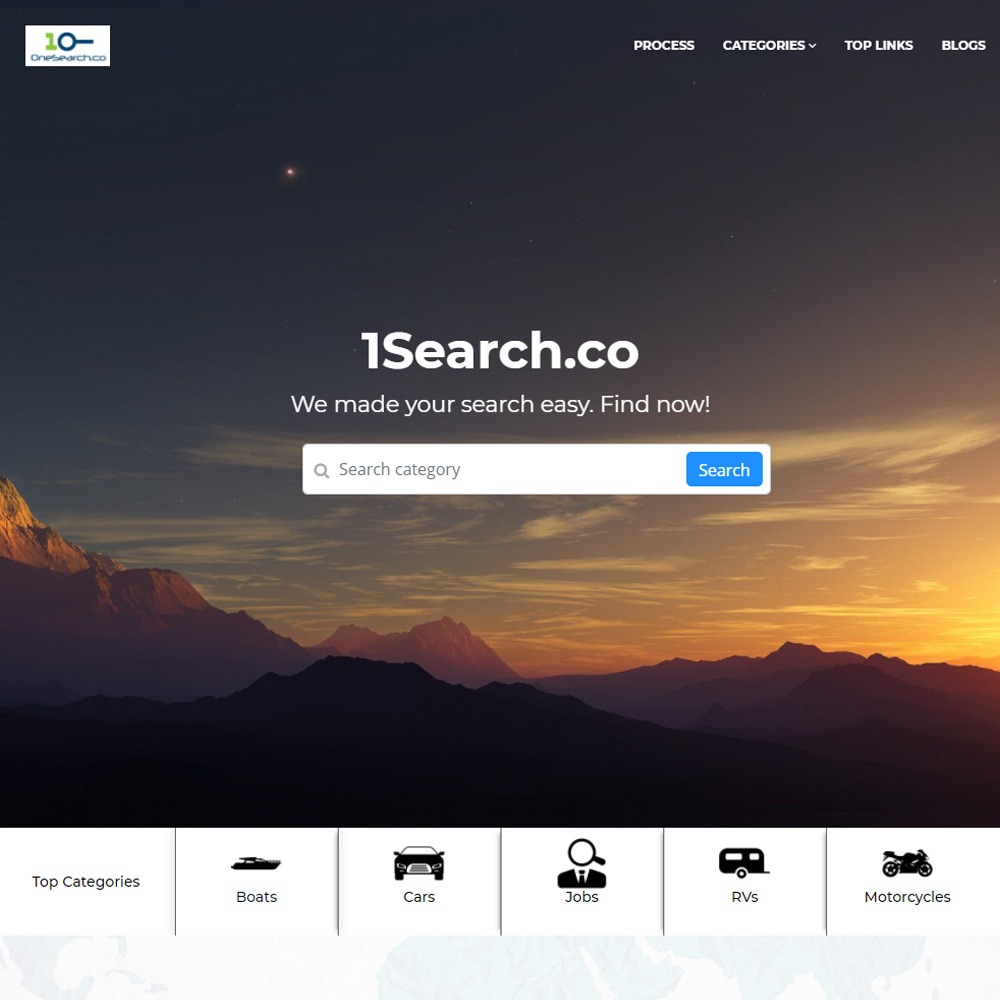
At OneSearch.co, we make your search easy and hassle-free with all the top links for each category in three simple steps. Here's how we did it and the technologies we used.
<h2>Step-by-Step Development Process</h2>
<h4>Step 1: Identifying User Needs and Categories</h4>
<ul>
<li><strong>Understanding User Requirements:</strong> We began by identifying the needs of our users and categorized these needs into over 15 different categories, ensuring comprehensive coverage for various interests and requirements.</li>
<li><strong>User-Friendly Interface Design:</strong> We designed an intuitive and user-friendly interface to make the selection of categories straightforward and engaging.</li>
</ul>
<h4>Step 2: Frontend Development</h4>
<ul>
<li><strong>Framework:</strong> We used CodeIgniter, a powerful PHP framework, to build the robust and scalable frontend of our application.</li>
<li><strong>Interactivity:</strong> To enhance user experience, we integrated JavaScript for dynamic and interactive elements, ensuring that users can easily navigate and interact with the platform.</li>
<li><strong>Responsive Design:</strong> Ensured that the website is responsive and works seamlessly across different devices and screen sizes.</li>
</ul>
<h4>Step 3: Backend Development and Data Scraping</h4>
<ul>
<li><strong>Data Scraping with Python Flask:</strong> We utilized Python Flask for web scraping. This allows us to fetch real-time data from multiple websites based on user-selected filters.
<ul>
<li><strong>Why Python Flask?</strong> It is lightweight, easy to set up, and excellent for web scraping tasks due to its simplicity and flexibility.</li>
</ul>
</li>
<li><strong>Filter Implementation:</strong> Our system allows users to filter results according to their specific needs. The filters are sent to the backend, where Python scripts scrape the necessary data from various sources.</li>
</ul>
<h4>Step 4: Containerization and Orchestration</h4>
<ul>
<li><strong>Docker:</strong> To ensure consistency and scalability, we containerized our applications using Docker. Each component of the application runs in its own container, making it easy to manage dependencies and updates.</li>
<li><strong>Kubernetes:</strong> For orchestration, we used Kubernetes. This enables automated deployment, scaling, and management of containerized applications, ensuring high availability and reliability of our service.</li>
</ul>
<h4>Step 5: Database Management</h4>
<ul>
<li><strong>Couchbase:</strong> We chose Couchbase for our database needs due to its high performance, scalability, and flexibility in handling various types of data. It supports both key-value and document-based storage, making it ideal for our diverse data requirements.</li>
</ul>
<h2>How OneSearch.co Works</h2>
<ul>
<li><strong>Select a Category:</strong> Start by selecting the category that best fits your needs from our comprehensive list of over 15 categories.</li>
<li><strong>Apply Filters:</strong> Use our advanced filtering options to narrow down the search results according to your specific requirements.</li>
<li><strong>Explore Listings:</strong> Instantly explore listings from multiple websites, all conveniently aggregated and tailored to your filters.</li>
</ul>
<h2>Benefits of OneSearch.co</h2>
<ul>
<li><strong>Ease of Use:</strong> Our platform simplifies the search process, making it quick and hassle-free.</li>
<li><strong>Comprehensive Results:</strong> By aggregating listings from multiple websites, we provide a one-stop solution for all your search needs.</li>
<li><strong>Customizable Filters:</strong> Advanced filtering options ensure that you get the most relevant results tailored to your preferences.</li>
<li><strong>High Performance:</strong> Leveraging cutting-edge technologies like Docker, Kubernetes, and Couchbase, we ensure a fast and reliable user experience.</li>
</ul>
<h2>Conclusion</h2>
With OneSearch.co, we have combined the power of modern web technologies to create a seamless and efficient search platform. Our meticulous development process and robust technology stack ensure that users have access to a fast, reliable, and user-friendly service.
Experience the future of search with OneSearch.co – your go-to platform for a hassle-free and comprehensive search experience.
- client: Enterprise search client
- Location: USA
- Year Of Complited: 2018

Beezone
<h2>Transforming Static HTML to Dynamic WordPress: A Case Study on BeeZone</h2>
<h4>Introduction</h4>
BeeZone Library, a comprehensive online platform, initially housed its vast collection of resources across thousands of static HTML pages. While functional, this setup posed significant challenges in terms of content management, user experience, and scalability. To address these issues, we embarked on an ambitious project to transform BeeZone into a dynamic, user-friendly website using WordPress. This document outlines our approach, processes, and the benefits realized through this transformation, showcasing our capability to deliver similar results for other clients.
<h4>Project Overview</h4>
<strong>Objective:</strong> Convert BeeZone's 1000+ static HTML pages into a dynamic WordPress site, creating a structured and manageable platform that enhances user experience and streamlines content management.
<h4>Scope:</h4>
<ul>
<li>Convert static HTML pages to WordPress.</li>
<li>Create a logical category and sub-category structure based on the existing HTML folder hierarchy.</li>
<li>Enhance site functionality and usability.</li>
<li>Ensure SEO optimization and improved site performance.</li>
</ul>
<h2>Step-by-Step Process</h2>
<h4>1. Initial Assessment and Planning</h4>
<h6>Site Audit:</h6>
<ul>
<li>Conducted a comprehensive audit of the existing HTML site to understand the content volume, structure, and specific requirements.</li>
<li>Identified key content areas, user journeys, and SEO considerations.</li>
</ul>
<h6>Planning:</h6>
<ul>
<li>Developed a detailed project plan outlining each phase, milestones, and deliverables.</li>
<li>Allocated resources and defined roles for team members.</li>
</ul>
<h4>2. Content Migration Strategy</h4>
<h6>Content Mapping:</h6>
<ul>
<li>Mapped existing HTML content to the new WordPress structure, ensuring each page's integrity and relevance.</li>
<li>Organized content into logical categories and sub-categories based on the HTML folder structure.</li>
</ul>
<h6>Tool Selection:</h6>
<ul>
<li>Selected appropriate tools and plugins for efficient content migration, such as WP All Import, ensuring minimal disruption and data accuracy.</li>
</ul>
<h4>3. Creating Categories and Sub-Categories</h4>
<h6>Structured Taxonomy:</h6>
<ul>
<li>Developed a structured taxonomy reflecting the original HTML folder hierarchy.</li>
<li>Created categories and sub-categories to facilitate easy navigation and content discovery.</li>
</ul>
<h6>Content Organization:</h6>
<ul>
<li>Assigned migrated content to the appropriate categories and sub-categories.</li>
<li>Implemented tagging and custom fields for enhanced searchability and filtering.</li>
</ul>
<h4>4. Enhancing Functionality</h4>
<h6>Custom Features:</h6>
<ul>
<li>Integrated custom features such as advanced search, user accounts, and interactive elements to improve user engagement.</li>
<li>Implemented a robust content management system (CMS) for easy content updates and management.</li>
</ul>
<h6>SEO Optimization:</h6>
<ul>
<li>Conducted on-page SEO optimization, including meta tags, URL structures, and internal linking.</li>
<li>Set up SEO plugins like Yoast SEO to maintain ongoing optimization efforts.</li>
</ul>
<h4>5. Testing and Quality Assurance</h4>
<h6>Comprehensive Testing:</h6>
<ul>
<li>Conducted thorough testing across different devices and browsers to ensure consistent performance and user experience.</li>
<li>Addressed any issues related to broken links, missing content, or design inconsistencies.</li>
</ul>
<h6>User Feedback:</h6>
<ul>
<li>Collected feedback from key stakeholders and a select group of users to refine and improve the site.</li>
</ul>
<h4>6. Launch and Post-Launch Support</h4>
<h6>Soft Launch:</h6>
<ul>
<li>Performed a soft launch to monitor real-time performance and user interaction.</li>
<li>Made necessary adjustments based on initial feedback and performance metrics.</li>
</ul>
<h6>Full Launch:</h6>
<ul>
<li>Officially launched the new dynamic BeeZone website.</li>
<li>Provided post-launch support to address any issues and ensure smooth operation.</li>
</ul>
<h6>Benefits Realized</h6>
<ul>
<li><strong>Improved User Experience:</strong> Enhanced navigation, search functionality, and responsive design significantly improved user satisfaction and engagement.</li>
<li><strong>Streamlined Content Management:</strong> The WordPress CMS allows for easy content updates, reducing the time and effort required to manage the site.</li>
<li><strong>Scalability:</strong> The new dynamic site structure supports future growth and content additions without compromising performance.</li>
<li><strong>SEO and Performance Boost:</strong> Optimized site structure and SEO practices resulted in better search engine rankings and faster load times.</li>
</ul>
- client: Digital library client
- Location: USA
- Year Of Complited: 2018
360 Alumni
<h2>An alumni engagement platform built around directory and events</h2>
Alumni platforms fail for a predictable reason: graduates sign up once, find the directory stale or the events calendar empty, and never return. Engagement decays and the institution loses its most valuable network. The brief was a platform where the data stayed current because members had a reason to maintain it themselves.
<h2>The problem</h2>
The institution held alumni records across disconnected systems — registrar data, event attendance, donor records, mailing lists — with no single view and no way for graduates to correct their own information. Staff spent more effort reconciling records than running programmes.
<h2>What we built</h2>
<ul>
<li><strong>Searchable alumni directory</strong> with member-controlled profiles — graduates maintain their own records, which keeps the data current without staff intervention.</li>
<li><strong>Events module</strong> covering creation, registration, capacity, and attendance tracking, connected back to member profiles so engagement history is visible.</li>
<li><strong>Role-based access control</strong> separating what administrators, chapter leaders, and members can see and do — necessary for a system holding contact details for thousands of people.</li>
<li><strong>CodeIgniter back end with a JavaScript front end</strong>, chosen for a small operational footprint and hosting economics that suit an institution rather than a venture-funded product.</li>
<li><strong>Privacy controls</strong> at the field level, so members choose what is visible to the wider network.</li>
</ul>
<h2>The design principle</h2>
Every feature had to give the member a reason to return. A directory is only useful if it is accurate, and it is only accurate if the people in it maintain it — which they only do if the platform is worth opening. Engagement and data quality are the same problem.
<h2>Outcome</h2>
A single system for alumni records, events, and communication, with the maintenance burden distributed to the people best placed to carry it.
- client: Higher-education client
- Location: USA
- Year Of Complited: 2018

Globalinfo Tech
<h4>1. Initial Planning and Requirements Gathering</h4>
<ul>
<li>Conduct meetings with the client to understand their needs.</li>
<li>Define the target audience and website goals.</li>
<li>Create a detailed list of required features (e.g., contact forms, service pages, etc.).</li>
<li>Discuss design preferences, brand colors, and overall aesthetic.</li>
<li>Establish project timeline and budget.</li>
</ul>
<h4>2. Domain and Hosting Setup</h4>
<ul>
<li>Choose and register a domain name that represents the company's brand (e.g., www.globalinfotech.com).</li>
<li>Select a reliable hosting provider (e.g., Bluehost, SiteGround, or WP Engine).</li>
<li>Set up hosting account and configure DNS settings for the domain.</li>
</ul>
<h4>3. WordPress Installation</h4>
<ul>
<li>Use the hosting provider’s one-click WordPress installation tool or manually install WordPress.</li>
<li>Configure basic settings (site title, tagline, and admin user).</li>
</ul>
<h4>4. Theme Selection and Customization</h4>
<ul>
<li>Choose a premium or free theme suitable for IT consultants (e.g., Astra, Divi, or a custom theme).</li>
<li>Install and activate the chosen theme.</li>
<li>Customize the theme using the WordPress Customizer or a page builder (e.g., Elementor, WPBakery).</li>
</ul>
<h4>5. Essential Plugins Installation</h4>
<ul>
<li>Install and activate essential plugins:
<ul>
<li>SEO: Yoast SEO or Rank Math</li>
<li>Security: Wordfence or Sucuri</li>
<li>Backup: UpdraftPlus or BackupBuddy</li>
<li>Contact Forms: WPForms or Contact Form 7</li>
<li>Analytics: Google Analytics Dashboard for WP (GADWP)</li>
<li>Performance: W3 Total Cache or WP Super Cache</li>
</ul>
</li>
</ul>
<h4>6. Website Structure and Content Creation</h4>
<ul>
<li>Create necessary pages (Home, About Us, Services, Blog, Contact, etc.).</li>
<li>Add content to each page, ensuring it is SEO-optimized.</li>
<li>Include high-quality images, videos, and graphics as needed.</li>
<li>Set up a blog section for regular updates and articles.</li>
</ul>
<h4>7. Custom Functionality and Features</h4>
<ul>
<li>Implement custom forms for lead generation and contact.</li>
<li>Integrate third-party services (e.g., CRM, email marketing tools).</li>
<li>Set up client testimonials and case studies sections.</li>
<li>Add a portfolio section showcasing past projects.</li>
<li>Configure a live chat feature if required.</li>
</ul>
<h4>8. Testing and Quality Assurance</h4>
<ul>
<li>Test the website on different browsers (Chrome, Firefox, Safari) and devices (desktop, tablet, mobile).</li>
<li>Verify all forms, links, and interactive elements work correctly.</li>
<li>Perform speed and performance tests (using tools like GTmetrix or Google PageSpeed Insights).</li>
<li>Conduct an SEO audit to ensure the site is search-engine friendly.</li>
</ul>
<h4>9. Client Review and Feedback</h4>
<ul>
<li>Schedule a review meeting with the client.</li>
<li>Provide a walkthrough of the website’s features and content.</li>
<li>Gather feedback and make necessary adjustments based on client input.</li>
</ul>
<h4>10. Launch Preparation</h4>
<ul>
<li>Perform a final round of testing and quality assurance.</li>
<li>Set up website analytics and monitoring tools.</li>
<li>Create a backup of the final website version.</li>
<li>Plan a launch date with the client.</li>
</ul>
<h4>11. Website Launch</h4>
<ul>
<li>Switch the website from the staging environment to the live server.</li>
<li>Announce the website launch via the client’s social media and email newsletter.</li>
<li>Monitor the website for any immediate issues post-launch.</li>
</ul>
<h4>12. Post-Launch Support and Maintenance</h4>
<ul>
<li>Offer a maintenance plan covering regular updates, backups, and security checks.</li>
<li>Provide training to the client on managing and updating the website.</li>
<li>Be available for troubleshooting and additional feature requests.</li>
</ul>
- client: Global InfoTech
- Location: USA
- Year Of Complited: 2019